



Organizations today have unprecedented opportunities to accelerate innovation and create measurable business value.
Every enterprise seeking sustained growth must master efficiency, consistency, and speed. A proven way to achieve this is by establishing a Center of Excellence.
A Center of Excellence is not merely a functional team. It is a structured framework that consolidates expertise, embeds governance, and scales repeatable best practices.
With this foundation, organizations can elevate customer experience, improve operational resilience, and lead digital transformation.
This article provides a comprehensive guide to building such a Center of Excellence. You will learn how to define its purpose, select the right type, and establish the structures and processes that sustain impact.
The insights here will help you design, launch, and scale a CoE that drives transformation across functions and domains.
Understanding the Purpose of a CoE
A Center of Excellence is designed to deliver measurable outcomes by consolidating expertise, governance, and repeatable processes.
It is not an additional layer of management but a structured body that ensures consistency, efficiency, and scale within a chosen domain. Its purpose is to embed excellence into both strategy and execution.
The CoE has two primary dimensions. Strategically, it provides thought leadership, sets guardrails, and influences enterprise-level decisions.
Operationally, it supplies standardized tools, templates, and processes that reduce complexity and accelerate delivery. In both dimensions, the value lies in making performance predictable, innovation structured, and outcomes measurable.
To translate this into practice, you should:
- Clarify the business outcomes the CoE must impact. Define whether the focus is on accelerating innovation, reducing costs, improving compliance, or enhancing delivery speed.
- Codify and enforce standards. Develop reusable methods and practices that reduce duplication and establish consistency across projects and units.
- Enable knowledge sharing. Build channels that connect experts across functions, ensuring insights and solutions are accessible organization-wide.
- Position the CoE as a partner. Provide structured guidance, tools, and hands-on support to ongoing initiatives rather than acting as a controlling body.
- Introduce repeatable assets. Supply frameworks, checklists, and process templates that reduce reliance on individual expertise and ensure scale.
You need a CoE when specialized expertise is repeatedly required, when innovation lacks direction, or when speed-to-market is critical but current approaches are inconsistent. By understanding this purpose and translating it into clear actions, you can establish a CoE that strengthens operational foundations while shaping strategic direction.
Types of CoEs
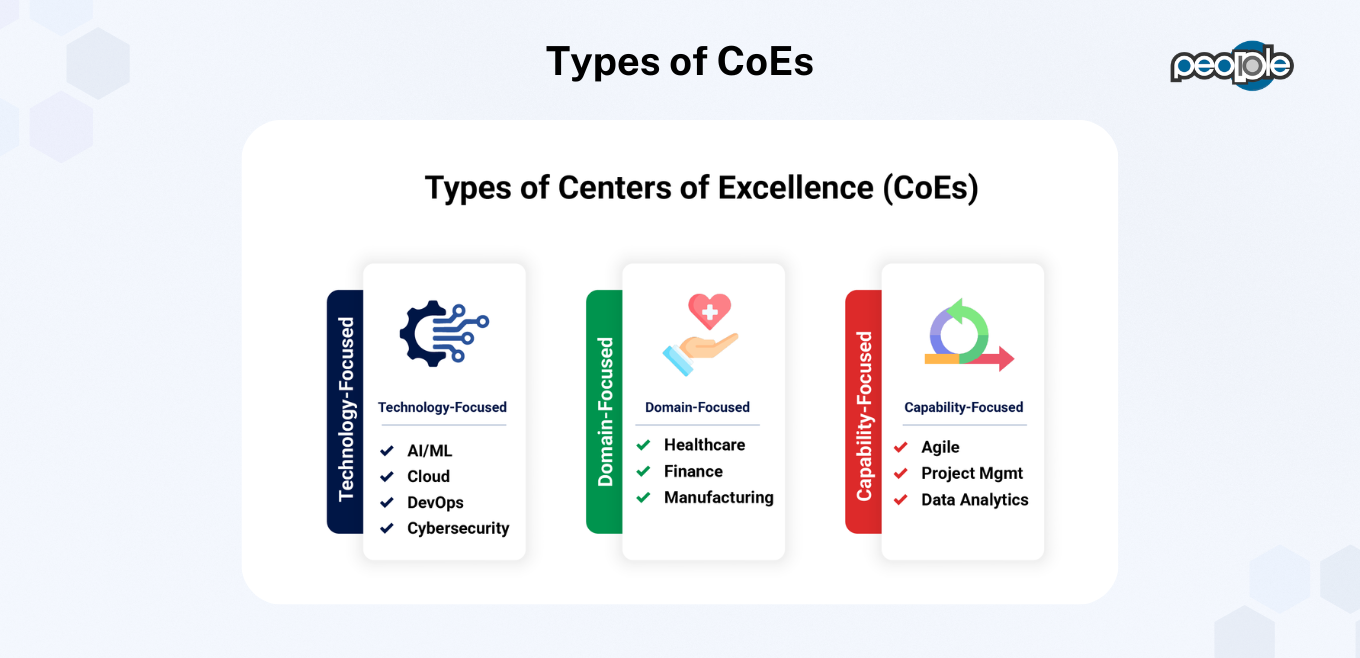
A Center of Excellence can take different forms depending on the challenges you want to solve and the outcomes you expect. The type you establish must align with your organization’s priorities, current maturity, and long-term strategy. Choosing the right focus area ensures that the CoE generates impact from day one and scales with purpose.
Broadly, CoEs can be categorized into three types:
- Technology-focused CoEs. These address specific technology domains such as AI/ML, Cloud, DevOps, or Cybersecurity. They drive adoption of emerging technologies, build reusable assets, and ensure that technology investments deliver sustainable business value.
- Domain-focused CoEs. These concentrate on verticals like Healthcare, Finance, or Manufacturing. They consolidate regulatory expertise, best practices, and domain knowledge to ensure compliance, operational efficiency, and sector-specific innovation.
- Capability-focused CoEs. These strengthen organizational capabilities such as Agile Delivery, Project Management, or Data Analytics. They improve the way teams deliver, scale practices across units, and create consistency in execution.
To determine which type of CoE is right for you, you should:
- Start by analyzing strategic priorities. Identify the domains or technologies most critical to achieving your growth agenda.
- Assess organizational maturity. Determine whether the biggest gaps are in technology adoption, domain expertise, or delivery capabilities.
- Prioritize areas with recurring demand. Focus on functions where specialized expertise is required repeatedly across projects.
- Validate with business outcomes. Ensure that the CoE type you select has a clear path to measurable improvements in speed, quality, compliance, or innovation.
By selecting the right type, you ensure that the CoE does not remain theoretical but
becomes a practical engine for transformation.
Step-by-Step Guide to Setting Up a CoE
Establishing a Center of Excellence requires a structured approach. Each step builds the foundation for consistency, adoption, and long-term impact. When executed in sequence, these steps transform a CoE from a concept into a measurable driver of business value.
a. Define Vision and Objectives
A CoE must begin with a vision directly tied to business priorities. The vision clarifies purpose, inspires adoption, and ensures strategic alignment. The objectives should be SMART—specific, measurable, achievable, relevant, and time-bound.
What to do:
- Define the problem to solve. For example, long software release cycles or inconsistent compliance practices.
- Tie objectives to business outcomes. For instance, improve software delivery speed by 30% within 12 months.
- Set standardization goals. Example: unify data governance practices across all departments to improve regulatory readiness.
b. Secure Executive Sponsorship
A CoE needs strong executive backing to gain traction. Sponsorship ensures financial support, organizational influence, and sustained momentum.
What to do:
- Engage an executive sponsor early. Their role is to champion the CoE across leadership forums.
- Ensure active participation. Sponsors must clear roadblocks, endorse priorities, and support funding cycles.
- Example: A CIO-led sponsorship of a Cloud CoE accelerates adoption across business units.
c. Identify Scope and Focus Areas
Start with a limited, high-value scope to deliver quick wins and build credibility.
What to do:
- Choose one or two pilot areas. For example, automate repetitive QA tasks or create a reusable library of AI models.
- Define services clearly. Include consulting, execution, and training.
- Specify target users. Internal delivery teams, customer-facing teams, or both.
d. Design the Governance Model
Governance ensures accountability, transparency, and scalability of operations.
What to do:
- Select a governance structure. Centralized for strong control, federated for distributed expertise, or hybrid for balance.
- Assign roles and responsibilities. Examples include CoE Lead, Domain Experts, and Delivery Managers.
- Standardize processes. Define demand intake, prioritization, escalation, and feedback loops.
e. Build the CoE Team
The team defines the CoE’s credibility and capability. Select individuals who can blend
deep expertise with influence.
What to do:
- Appoint a CoE Head. This leader defines the vision and ensures strategic alignment.
- Include Subject Matter Experts. They provide technical or domain depth.
- Add Evangelists. Their role is to promote adoption and demonstrate value.
- Example: A Data Analytics CoE may include data scientists, visualization experts, and governance specialists.
f. Define the Operating Model
The operating model describes how the CoE will interact with the rest of the organization.
What to do:
- Select a service model. Choose consulting (advise), delivery (execute), or enablement (train).
- Establish engagement channels. Example: a ticketing system for requests or structured workshops for adoption.
- Create a knowledge repository. Provide templates, case studies, and reusable assets.
g. Establish Tools, Processes, and Infrastructure
Tools and processes are the backbone of scale. Without them, knowledge remains fragmented and impact diluted.
What to do:
- Select collaboration tools. Enable real-time communication and shared documentation.
- Define project tracking systems. Standardize request intake, prioritization, and reporting.
- Implement performance dashboards. Measure adoption, cycle time, and impact on business outcomes.
- Example: A DevOps CoE can standardize pipelines, automate deployments, and track metrics in a central dashboard.
Launching the CoE
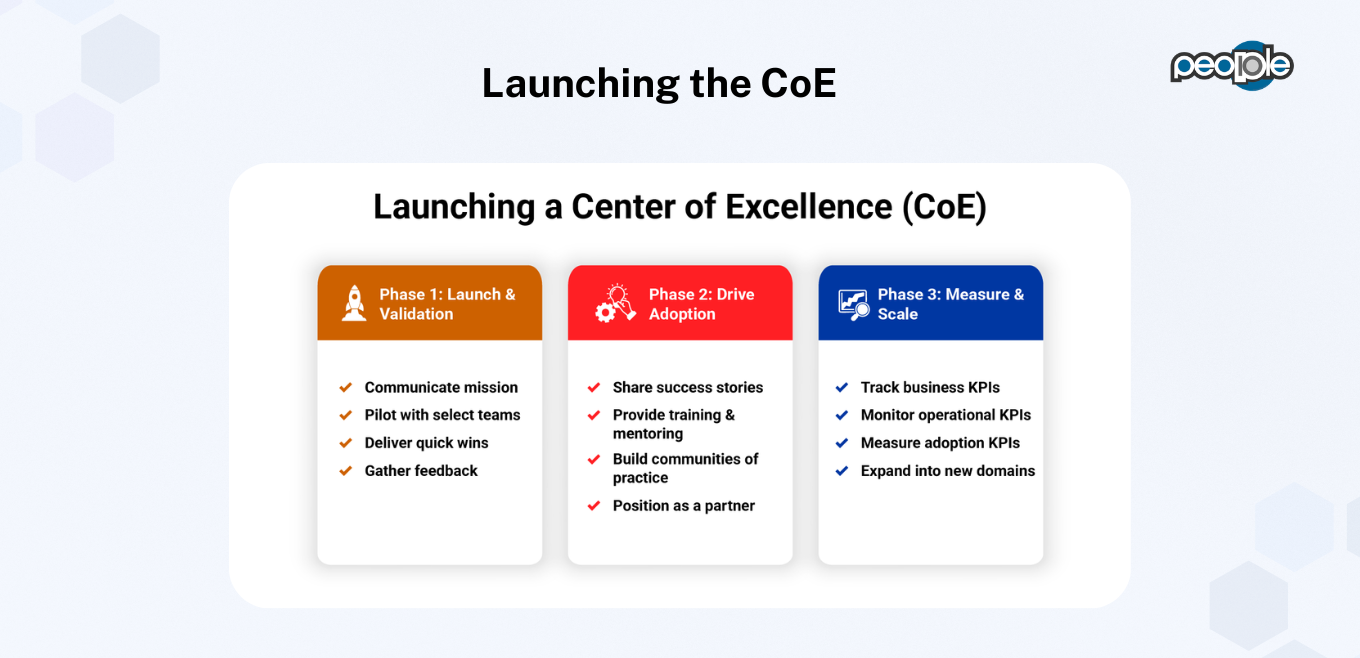
A successful CoE launch begins with validation and credibility. A soft launch or pilot phase allows you to test the model, gather feedback, and refine operations. Early wins build momentum and prove the value of the CoE across the organization.
What to do in the launch phase:
- Communicate the mission and services clearly. Ensure every stakeholder understands why the CoE exists and how to engage with it.
- Select pilot teams strategically. Partner with teams facing recurring challenges where the CoE can deliver visible improvements quickly.
- Deliver measurable early wins. For example, automate a repetitive testing process or standardize reporting formats across pilot projects.
- Gather structured feedback. Use retrospectives, surveys, or workshops to identify gaps and refine the model.
Driving adoption requires embedding the CoE into the organization’s culture and practices. Sustained engagement comes from positioning the CoE as a value-adding partner rather than an oversight function.
How to drive adoption and sustain value:
- Promote success stories. Share results through newsletters, intranet updates, or town halls to inspire wider adoption.
- Offer structured learning. Provide training, certifications, and mentoring to build internal champions.
- Build communities of practice. Enable teams to share experiences, adopt standards, and co-create innovation.
- Position the CoE as a partner. Make it easy for teams to collaborate and avoid being seen as a gatekeeper.
Measuring success is essential to maintain credibility and secure continued investment. Metrics should demonstrate both business impact and operational improvements.
What to measure and track:
- Business KPIs. Cost savings, efficiency gains, or revenue impact.
- Operational KPIs. Reduction in cycle time, improved quality, or fewer deployment issues.
- Adoption KPIs. Number of teams engaged, repeat usage of assets, or demand for CoE services.
As the CoE stabilizes, challenges will surface. Resistance can be addressed through awareness sessions and strong stakeholder engagement. Scope confusion must be avoided by communicating the CoE’s mandate clearly. Resource constraints should be managed by prioritizing high-impact areas first.
Over time, the CoE should evolve and scale. Expansion into new domains or integration with larger transformation programs strengthens its relevance. In some cases, a CoE may mature into a fully operational unit. Planning proactively for such transitions ensures continuity without disrupting value delivery.
When executed with discipline, these steps embed the CoE into the organizational fabric, making it a long-term engine of innovation, efficiency, and competitive differentiation.
Building the Future with a Center of Excellence
A disciplined approach to building a CoE ensures that it becomes more than a structural initiative. It evolves into a driver of measurable outcomes—accelerating innovation, improving efficiency, and enabling scalable growth. The key is to begin with a focused scope, demonstrate value quickly, and expand with purpose.
When designed thoughtfully, a CoE not only standardizes processes but also creates a sustainable framework for transformation. It empowers teams with repeatable methods, fosters collaboration across units, and establishes a culture of continuous improvement.
By starting small and scaling strategically, you can embed a CoE as the engine of enterprise transformation. The result is not incremental improvement but a fundamental shift toward agility, resilience, and long-term competitiveness.
Author

Nandakumar excels in delivering diverse solutions from mobile apps to complex enterprise systems. At People10, he continues to drive success with a focus on customer satisfaction and innovative technology solutions.